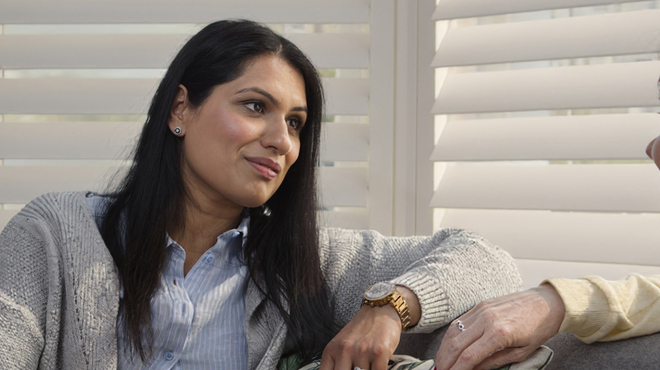
Every fall, millions of viewers watch Carrie Ann Inaba light up the ballroom weekly on a hit television dance competition. What they can't see is the disease she's been navigating for more than a decade.

"I suffered in silence for a long time," Carrie Ann says. "I don't want anyone else to feel that way."
Carrie Ann is living with Sjögren's disease—a systemic autoimmune disease that can be serious and progressive, meaning it can affect the entire body rather than just one area.1-4 Although the most common symptoms include dry eyes and mouth, fatigue, and joint pain, the disease can also have widespread impacts, including inflammation and damage to other body systems.5,6 Many of its symptoms are not visible, and people living with Sjögren's often suffer silently, dismissed by both the people around them and healthcare providers due to under-recognition of the disease and underappreciation of its burden. 7,8
This spring, Novartis launched the SJÖUT for Sjögren's disease education campaign in partnership with Carrie Ann. Through a video series on SjoutForSjogrens.com, the campaign helps people living with Sjögren's connect the dots of their symptoms, find their voice, and advocate without apology.
"You are not alone,” she says. “When we speak up, others see themselves in us, and together, we can help each other.”
A Decade Without Answers
Sjögren's disease presents as a range of diverse, seemingly unrelated symptoms that often mimic other conditions such as lupus, fibromyalgia, or chronic fatigue syndrome. As a result, it can take years for patients and physicians to piece together a diagnosis.9,10
Carrie Ann's journey is a case in point. Her earliest symptoms trace back to childhood, including recurring irritated and damaged corneas that sent her to eye doctors for years without resolution.11 As an adult, she repeatedly asked her ophthalmologist for a simple diagnostic test to assess tear production but was told it was unnecessary.
It took a decade of debilitating symptoms and multiple doctors before Carrie Ann received her diagnosis. In 2013, a rheumatologist ordered the blood work she needed, confirming Sjögren's disease.
The diagnosis brought clarity, but not relief. After years of having her symptoms overlooked and minimized, Carrie Ann went through a period of anxiety and depression.
The Weight of an Invisible Disease
People living with Sjögren's disease often face a physical, mental, and economic burden that goes unseen, although everyone's experience is different.8,12 For Carrie Ann, the disease is a constant presence. Beyond chronic dry eyes, she manages significant fatigue, pain, dry mouth, and dry skin.13

I needed a guide on how to live with Sjögren's. I didn't get that from the medical system. I got it from other patients.
-Carrie Ann Inaba, dancer, TV personality, and Sjögren's disease advocate
"Looking back, it was all connected," she says. "It is your whole body. When one part is not functioning, others flare up."
For years, she carried the burden of this invisible disease alone—the shame, the isolation, the loss of identity. Her search for answers led her to an online patient community. For the first time, she felt understood and had access to the support and practical advice she’d been missing. "I needed a guide on how to live with Sjögren's," she says. "I didn't get that from the medical system. I got it from other patients."
Redefining What a Full Life Looks Like
"I live my life so much differently now," she says. Carrie Ann treats scheduling as self-care, planning for rest days and practicing what she calls "energy management," which means listening to her body rather than pushing through it. She has identified her triggers and avoids anything that causes inflammation.
"My life may look different on the outside," she says. "But it feels larger and fuller on the inside."
She also assembled a care team that works in concert to optimize her health and has become fluent in reading her own labs and charts—a level of health literacy she developed out of necessity.
But the biggest shift has been internal.
"I learned to trust myself and what my body is telling me,"she says. "It's been a radical re-prioritization of my life. I'm grateful for it."
Speaking Up Without Apology
The experience of finding that strength in herself and through shared stories is what drives Carrie Ann's advocacy today. She doesn't see speaking up as a personal act. She sees it as a gift to others.
“If you are struggling, know that we are all struggling,” she says. “We all have our own best life to live.”
That conviction is what drew her to the SJÖUT for Sjögren's campaign. In this video series, Carrie Ann sits down with Janet Church, President and CEO of the Sjögren's Foundation, fellow Sjögren's patient Jennifer Snook, and rheumatologist Dr. Tara Rizvi. Together, they share the moments they stayed silent, the symptoms they minimized, and the conversations they avoided, while offering tips on how undiagnosed and diagnosed patients can better advocate for themselves.
Through the SJÖUT for Sjögren's campaign, Novartis is working to ensure the Sjögren's community feels seen, heard, and supported.
“Being part of this campaign means I can create visibility, connection, and practical support on a bigger scale,” Carrie Ann says. “When patients share experiences, it’s validating. The community is real and help is possible.”
Carrie Ann brings her personal experience living with Sjögren's disease to inspire others to advocate without apology so they can get the care they deserve. Her message is direct: Trust yourself and your body. Ask questions. Keep searching for the right doctor. Find your people.
"I wouldn't be who I am without Sjögren's," she says. "It taught me to trust myself and advocate for myself. Now I want to help others do the same."
Visit SjoutForSjogrens.com to SJÖUT with Carrie Ann and Novartis—and learn more about the real impact of this serious autoimmune disease.